Industrial robots achieve very high repeatability. However, absolute accuracy—the ability to actually reach a specified pose in space precisely—can be significantly lower.
Comprehensive calibration significantly reduces these deviations. Geometric parameters and other factors relevant to accuracy are identified and included in a precise robot model. The resulting compensation data is then used for highly accurate robot control.
In particularly demanding applications, deviations remaining after this calibration can still be relevant. This is precisely where Tracker Guidance comes in.
An External High-Precision Pose Reference for the Robot
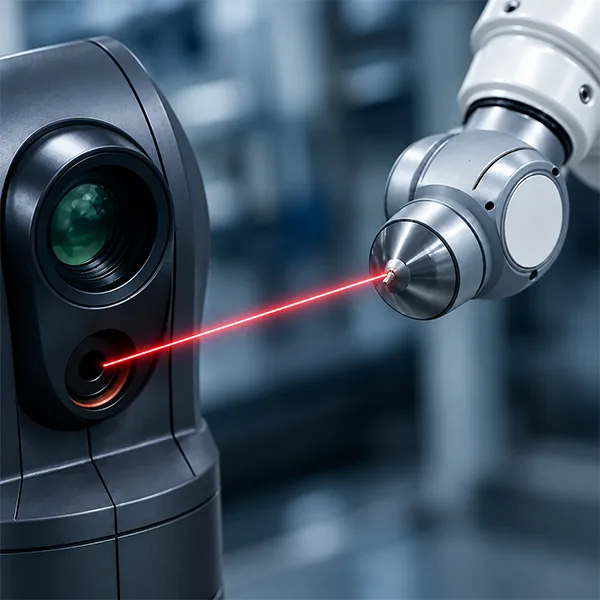
With Tracker Guidance, an external high-precision measurement system continuously records the actual position and orientation of the robot wrist during operation. Measurement takes place in parallel with robot motion at the controller’s interpolation cycle rate.
The system therefore knows not only the pose that the robot should have reached according to its internal model, but also receives independent information on where the robot wrist actually is.
This external reference forms the basis for real-time correction.
Continuous Correction during Motion
The key difference from conventional calibration is that Tracker Guidance does not merely store a correction determined once for use in subsequent movements.
Instead, during operation, the expected target pose is continuously compared with the measured actual pose. From the identified deviation, Tracker Guidance calculates the required corrective motion in each interpolation cycle and transmits it to the robot controller at the IPO cycle rate.
In simplified terms, this creates a continuous control loop:
Target pose → robot motion → external pose measurement → target/actual comparison → correction calculation → corrected robot motion
This process repeats continuously during motion.
Calibration and Tracker Guidance Work Together
Tracker Guidance does not replace precise robot calibration. The two technologies complement each other.
First, the overall system is comprehensively calibrated. This allows systematic errors to be compensated using the high-precision robot model.
Tracker Guidance then adds a further increase in accuracy: while the robot operates, remaining deviations are measured externally and corrected immediately. Corrective motion takes place within milliseconds. Full robot calibration before Tracker Guidance significantly shortens the control loop or corrective motion, ensuring maximum accuracy at high robot path speeds.
Accounting for Both Position and Orientation
For many high-precision manufacturing processes, determining the position of the tool centre point as precisely as possible is not enough. The tool’s spatial orientation is equally important.
Tracker Guidance accounts for the measured position and orientation of the robot wrist.
This is particularly relevant in applications where even small deviations in tool orientation can affect the machining result.
The Benefit Is Precision Where It Is Actually Needed
Combining a precise robot model with continuous external position feedback allows the absolute accuracy of a robot to be increased to the maximum.
Tracker Guidance is therefore particularly suitable for demanding applications such as milling, drilling, machining large components and other high-precision robot-assisted manufacturing processes where small pose and path deviations directly affect the quality of the process result.
The result is continuous real-time correction of robot motion for the most demanding requirements in absolute pose and path accuracy.