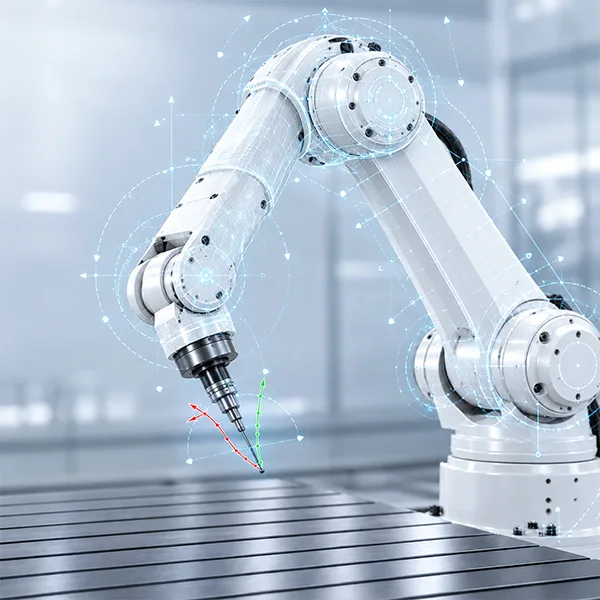
The actual pose of the Tool Center Point (TCP) is determined by numerous influencing factors. These include:
- geometric deviations of the individual robot axes and links,
- manufacturing and assembly tolerances,
- axis misalignment and joint errors,
- deviations in gearbox transmission behaviour,
- elastic deformation of joints and the robot structure,
- the robot’s own weight,
- tool weight and payload,
- the location of the load’s centre of gravity,
- tool and TCP deviations,
- the robot’s orientation,
- temperature-dependent and operating-condition-dependent changes.
The effects of these errors also vary across the workspace. Depending on joint configuration, orientation, tool and load, the robot may deform differently. An error that is barely relevant in one robot pose may have a significantly greater influence on the TCP pose in another configuration.
For the highest accuracy requirements, correcting only individual geometric parameters is therefore insufficient.
A Mathematical Model of the Real Robot
ISIOS takes a model-based approach. Highly accurate measurement data is used to determine the parameters of a complex mathematical model that describes the actual behaviour of the individual robot much more accurately than its nominal initial model.
Suitable robot poses are measured throughout the relevant workspace. The deviations between the calculated target pose and the actually measured pose allow the model parameters relevant to accuracy to be identified and optimised.
In addition to the kinematics themselves, other physical properties of the robot can also be incorporated into the modelling. The aim is not merely to describe a geometrically idealised robot, but to create the most accurate mathematical representation possible of its real behaviour.
From Measurement Data to a Precise Robot Model
The basic process comprises several steps:
1. Modelling
The kinematic structure of the robot and the additional factors relevant to accuracy are described mathematically.
2. Optimised Pose Selection
Suitable measurement poses are selected to enable the relevant model parameters to be identified as reliably as possible.
3. Highly Accurate Measurement
The robot moves to the defined positions and orientations. The poses actually reached are recorded using high-precision measurement technology.
4. Parameter Identification
The actual model parameters are determined by iteratively minimising the differences between the mathematically calculated robot pose and the actually measured pose.
5. Model Optimisation
The model parameters are optimised so that the model describes the behaviour of the real robot as precisely as possible throughout the entire relevant workspace.
6. Compensation
The identified deviations are taken into account and compensated when calculating the robot pose.
Why Elasticity and Loads Play an Important Role
An industrial robot is not a perfectly rigid system. Robot arms, joints and especially the drivetrains have finite stiffness.
As a result, the actual TCP pose changes depending on the robot configuration and load. The robot structure’s own weight affects the individual axes differently in each pose. Tool weight and payload add further effects.
The longer and heavier the tool used, the greater the effect that even small angular or joint deviations can have at the Tool Center Point.
A powerful robot model must therefore not only identify where the axes are located, but also account, as far as possible, for how the real robot behaves under the respective conditions.
From High Repeatability to High Absolute Accuracy
A robot can reach the same pose repeatedly with great reliability and still deviate significantly from the programmed target pose. High repeatability alone therefore says little about whether a robot actually reaches a pose specified by CAD data with precision, for example.
By contrast, offline programming, machining, measurement and other high-precision processes require high absolute accuracy.
Identifying and compensating systematic errors brings the mathematical model closer to the real robot. The difference between virtual and actual robot motion is reduced.